If you’ve taken a break from writing, restarting can feel hard.
You sit down with good intentions, and suddenly you’re thinking about everything at once:
- where you left off
- what needs fixing
- whether the idea still works
- how long it’s going to take.
Quick answer: how do I start writing again after a break?
- Set a 7-minute timer and write 100 to 200 words of a re-entry scene.
- Choose one prompt, write without planning, and stop when the timer ends.
The goal is momentum, not perfection.
Why restarting feels harder than it should
When you’ve been away from your draft for a while, you lose two things:
- Context (you forget what you were doing and why it mattered)
- Momentum (the habit has cooled down)
That’s normal.
But most writers make restarting ten times harder by treating it like a full reset.
New notebook. New outline. New method. Rewrite chapter one. Fix everything “before you continue”.
It feels productive, but it usually sends you straight into overwhelm.
The real solution is smaller and more practical:
Have a small target. This is better than having a big target that you absolutely dread and most likely, won’t beat.
The 7-minute restart plan
This plan is deliberately small. You’re going to do three things:
- Choose a tiny target
- Write a re-entry scene
- Stop on purpose
Step 1: choose a tiny target
Your target is 100 to 200 words.
Not 1,000 words. Not a chapter. Not an hour.
One to two hundred words is enough to restart the engine without waking up your inner perfectionist.
If that sounds “too small to matter”, stay with me. If you’re just starting out, you don’t need bigger goals – you need repeatable, achievable ones.
A small target you do four times a week beats a heroic target you do once a month.
Step 2: write a re-entry scene
A re-entry scene is a low-pressure scene that gets you back into your story world without needing a full plan first.
Think of it like turning the lights on in a room you have not walked into for a while. You’re not redecorating. You’re switching the lights on.
Set a timer for 7 minutes and write your 200 to 300 words using ONE of these prompts:
- Your main character walks into a room and immediately notices something that feels off.
Maybe it’s a smell. A silence. A detail that shouldn’t be there.
- Your main character wants something small, right now, and something gets in the way.
A phone call. A locked door. A person who refuses. A missing item.
- Your main character overhears a sentence they were never meant to hear.
A threat. A secret. A lie. A confession. Something that changes the temperature of the story.
Pick one. Start writing.
Do not pause to plan. You are not allowed to research anything during these 7 minutes.
You’re building momentum and proving to yourself: I’m back.
Step 3: stop on purpose
When the timer ends, stop.
Yes, even if it’s going well.
Stopping early creates a powerful psychological effect: it leaves you with something to return to.
It teaches your brain that writing is not an exhausting marathon session you have to dread.
“But I don’t know what 100 words looks like”
Most people overestimate what 100 to 200 words feels like because they picture a full page in a novel.
Here’s the truth: 100 words is roughly a short email section. It’s a few paragraphs. It’s a screenful.
If you can write a decent message to a friend, you can write 100 words.
And because it’s a re-entry scene, those words do not need to be perfect.
You’re building momentum, not writing Shakespeare.
Just so you know, the above paragraph, including this sentence, is 87 words.
What to do if you feel rusty
Rustiness is normal after a break. It does not mean you’ve lost your ability. It means you’ve paused the habit.
Here are three ways to make the restart even easier:
Option A: write the recap paragraph first
Before your re-entry scene, write 3 to 5 sentences answering:
- Where was my character last time?
- What do they want right now?
- What stands in the way?
You’re not planning, you’re orienting.
Option B: write badly on purpose for 2 minutes
Give yourself two minutes to write the worst version of the scene you can.
It sounds silly, but it breaks perfectionism quickly. Once you’ve written something deliberately rough, the pressure drops and the real writing starts.
One other thing I do that works for me: I write my first draft like a book my mum will never read. Try it for yourself and discover how liberating it is.
Option C: steal your own last line
Open your draft and copy the last sentence you wrote into a blank document.
Then write the next sentence.
That’s it. The smallest possible restart is often the most effective one.
What to do if your brain is loud right now
If you’re trying to start writing again after a break, your thoughts might sound like this:
- I’m behind already
- I’m rusty
- I don’t even know where to start
- I don’t have the time I thought I’d have
- I can’t concentrate like I could before
- I’ll do it at the weekend (and then I won’t)
If that’s you, you’re not a loser (or whatever name you call yourself because of this). You’re just at the exact point where a system matters. A system like:
It’s built for the exact moment when you want to write, but you can’t get traction (and please, stop calling yourself a loser).
One important warning: do not start over
After a break, a lot of writers get dramatic.
They want a fresh start, so they delete the draft, rewrite chapter one, change the main character’s name, change the tense, change the plot, change the genre.
Take it from a professional hybrid author (11 books and counting). Starting over feels productive, but it’s not.
Most aspiring authors don’t need a new draft (trust me, you don’t). You just need to finish the draft you have.
So here’s a rule:
No starting over. Only moving forward.
You can revise later. Revision is a stage. Restarting is a loop.
Break the loop.
How to use this for the rest of the week
If you want to turn this into a realistic habit, do this:
- Day 1: 7 minutes, re-entry scene
- Day 2: 7 minutes, continue the scene
- Day 3: 7 minutes, introduce a new obstacle
- Day 4: 7 minutes, end the scene with a question or decision
That’s under an hour total across four days.
You’ll have new words on the page, and more importantly, you’ll have proof that you can write even when life is busy.
That’s how you build a writing practice.
That’s how you build consistency.
That’s how you build discipline.
That’s how writers are built and books are written.
It’s realistic and it works.
If your real fear is “what if this book idea is the wrong one?”
Sometimes the blockage is not time or energy.
Sometimes it’s fear of wasting months, or years, on something that won’t work.
If that’s the voice you keep hearing, start with clarity before you pour effort into the draft.
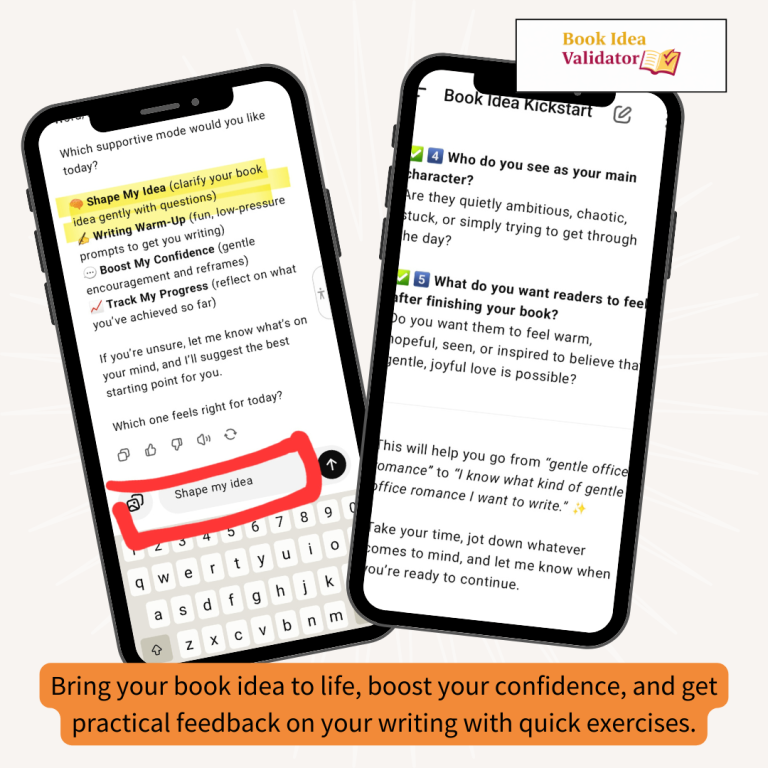
That’s exactly what my Book Idea Validator tool is for.
Run your idea through it and get a straight answer on whether it has legs, what genre promise it’s making, and what needs tightening so you can move forward with confidence.
FAQs about starting a book after a writing break
Aim for 100 to 200 words at a time. It is small enough to finish, but big enough to rebuild momentum.
A re-entry scene is a low-pressure scene that gets you back into your story world without needing a full plan first. It’s designed to restart momentum, not solve the whole plot.
Start with a recap paragraph (3 to 5 sentences) and then write the next sentence. Rust fades through repetition, not waiting.
No. Draft first. Editing activates perfectionism and slows momentum. Save editing for a separate session.
Clarity removes hesitation. If you want help, run it through the Book Idea Validator before you go all in.